


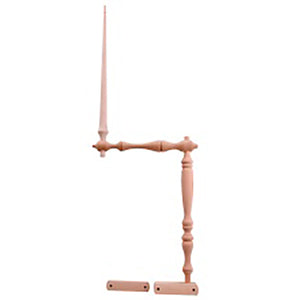
This FLAX DISTAFF is suitable for TRADITIONAL SPINNING WHEELS.
Experience the joy of creating your own linen yarn.
HOW TO DO IT
The flax fibers are held parallel with a ribbon on the distaff. From here, the fibers are drawn down towards the spinning wheel's rotating flyer unit, which consists of a bobbin, flyer, spindle, and whorls. The flyer unit gives the yarn the necessary twist during spinning.
Flax fibers twist naturally to the left, which is why the yarn should also be spun to the left in what is known as S-spinning.
During spinning, moisten your fingers with water. The water partially dissolves the pectin in the fibers, so they adhere more closely together and form a more uniform and strong yarn.
After spinning, the yarn can be used unbleached or bleached.
In the past, linen yarn was bleached using a weak base, for example, potash, soap or soda lye, as well as straw or beech ash. The yarn was boiled in the alkaline solution one or more times, rinsed, beaten with wooden paddles, and then hung outdoors for sun-bleaching for several months.
Any form of bleaching results in a significant loss of strength in the linen yarn. Fully bleached flax therefore has a tensile strength that is only about half that of unbleached flax.
Experience the convenience of swift order fulfillment with our top-notch Shipping services.
We offer delivery with GLS, DAO and POSTNORD to parcel shops and private addresses - read more about delivery terms here>>










